Your dog isn't
the limiter. You are.
A fit dog's VO2max sits around double an elite human's. Find out exactly how fit you need to get to keep up — with a VO2max and lactate threshold test, PawPace pace cards that show your real dog boost %, a detailed training report built around your goal, and 12 months of Dog Joggers to log every run with your dog.
Testing led by Jack Braniff — MSc Sport & Exercise Nutrition, SENr & CISSN registered, founder of Dog Joggers.
The uncomfortable truth
Your dog was built for this. You're the variable.
Canicross runners obsess over harness fit, line stretch, breed and conditioning. Reasonable things to obsess over. But none of it is the bottleneck. A fit dog's aerobic ceiling sits at roughly double even an elite human's — typical ranges, not a medical claim, but the gap is real and it isn't close.
Dogs are built to keep adapting to whatever pace you set — your dog will get fitter alongside you almost automatically. Yours won't, unless it's measured and trained deliberately. That's what this test is for: your own solo thresholds, not a number shared with the dog.
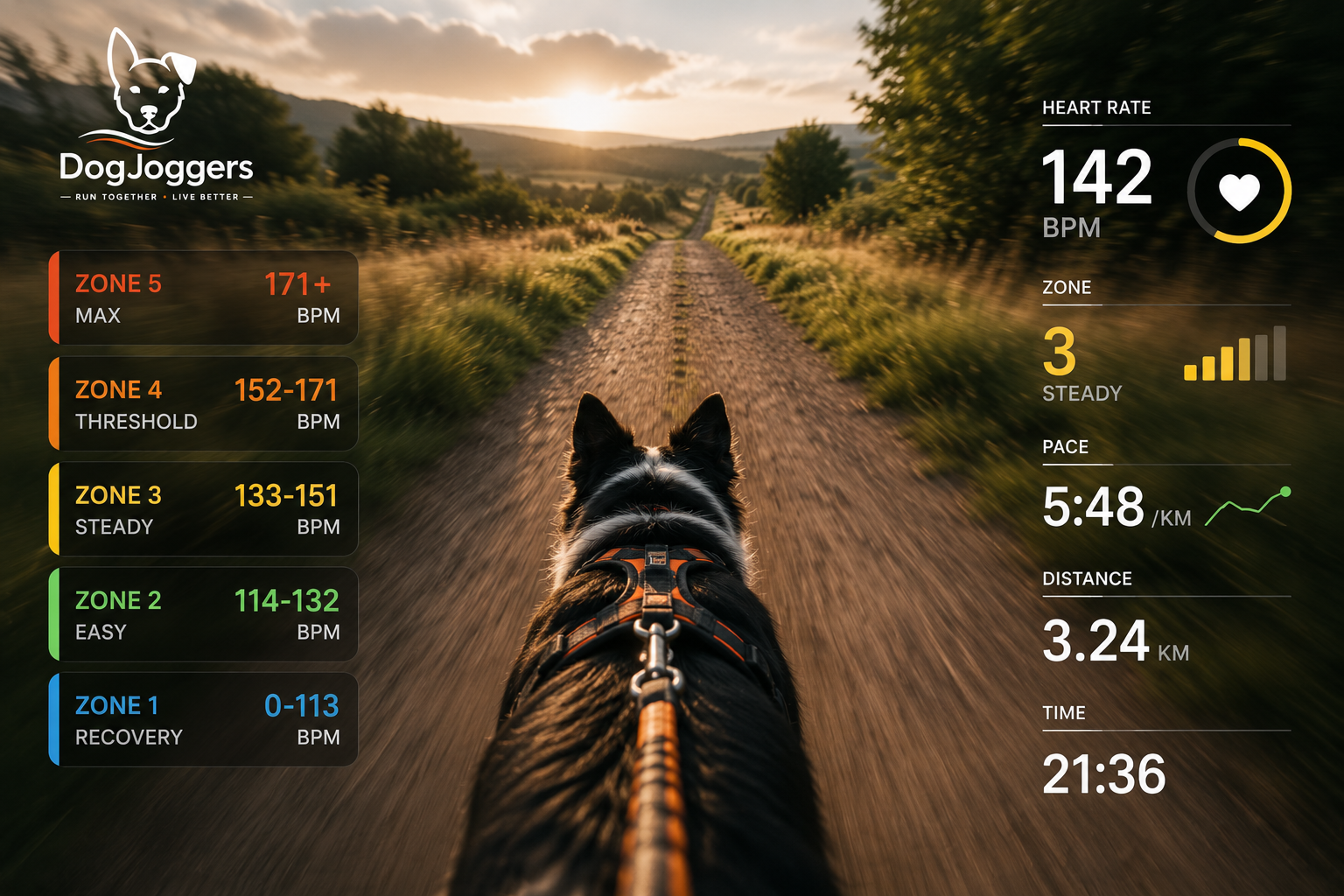
| Your personal zones (pace & heart rate) | What it trains |
|---|---|
| Zone 1 — Recovery | Easy aerobic work, active recovery |
| Zone 2 — Endurance | Fat-burning base, the engine room |
| Zone 3 — Tempo | Sustained 'comfortably hard' efforts |
| Zone 4 — Threshold | Solo race pace around LT2 |
| Zone 5 — VO2 Max | Short, maximal intervals |
How it works
The step test, drop by drop
Consultation
A 15-minute chat about your running background, canicross goals (or non-canicross goals — 5K, 10K, half, whatever you're training for), and any upcoming races.
Setup
Heart-rate monitor fitted and your fingertip or earlobe prepped for clean, quick sampling between stages.
Step test
You run stages of a few minutes each at increasing speeds, solo on the treadmill. At the end of every stage we take a small blood sample and log your lactate and heart rate.
Build the curve
We plot lactate against pace to identify LT1 and LT2 precisely, and read off your heart rate and pace at each threshold.
Debrief & report
Jack walks you through your curve, your threshold paces and your personal zones, and hands you a written training plan built around your goal.
Who it's for
Runners who want to close the gap
Pace your solo engine
Your dog isn't slowing down. Find your own solo threshold and train it up so you can hold more of what the dog can already do.
5K to marathon
This is the same test and report used across the site — build it around any race distance, canicross or not.
End the grey zone
If you're training off a watch estimate or a generic formula, testing tells you your real training and heart-rate zones — not a guess.
Included with your test · PawPace
Two ways we measure you
The lab test gives you your training zones and heart-rate zones straight from your physiology — no guesswork, no watch estimate, no generic formula. That's what happens in the lab.
PawPace is different: a simple field test you run yourself, outside of coming in. Run a 5K solo, then run one with your dog on the lead, and PawPace works out your pace zones for both — including exactly how much the pull changes your pace.
"Your dog makes you 8% faster than running solo." — a real number, from your own two 5K times, not a guessed multiplier.
You leave your test with your lab-verified training and heart-rate zones. PawPace is yours to run in your own time whenever you're ready — no equipment, just two 5K runs.
Not a mockup
What you actually walk out with
Two real results from the testing bench — the exact report format this test includes: your VO2max, your solo thresholds, your personal zones, a lactate curve, and a training plan built around them.
Z1 · Z2 · Z3 · Z4 · Z5 — 134–176 bpm
Five bands, each with an exact solo pace and heart-rate range — not a formula guess.
Z1 · Z2 · Z3 · Z4 · Z5 — 155–194 bpm
A national-level engine, still pinned to the decimal — VT1 at 63% of VO2max, VT2 at 81%.
The bundle
Test once. Train smarter for a year.
The test tells you where you are. Your report tells you exactly what to do about it — built around your goal, whatever that is. Dog Joggers is there alongside it, to log every run you do with your dog.
- Quick consultation — goals, experience, protocol
- Warm-up, then an incremental treadmill effort test
- Blood lactate sampling through the ramp
- A detailed written report and training plan, built around your goal — 5K, 10K, half marathon, or general fitness
- Full results debrief before you leave, ~75 min total
- PawPace — a self-run field test, done in your own time, for your solo and dog-lead pace zones
- Log every canicross run with your dog — distance, pace, session history
- A simple way to track progress together over the year
- Built by a coach who trains humans and dogs as one connected system
Common questions
Do I need to be an experienced canicross runner to do this test?
No. The protocol scales to your current fitness. If you already run seriously with your dog and want real zones instead of guesswork, this is built for you — whatever stage you're at.
What should I wear or eat before the test?
Wear the kit you'd normally run in. Arrive rested with no hard sessions in the previous 24 hours, and avoid a heavy meal in the 2–3 hours beforehand.
How long does the session take and where is it held?
Around 75 minutes in total, at the Box Nutrition testing lab in Birmingham. You'll get a full report and a 1:1 debrief before you leave.
What happens after the test — do I need my dog there?
No — the test itself is you on the treadmill, not your dog. Your zones go into your training report, and you keep using Dog Joggers to log the runs you do together.
How is this different from a generic VO2max test at a gym?
It's built specifically around training humans and dogs as one connected system — you get a detailed written report and training plan built around your own goal, plus 12 months of Dog Joggers to log every run with your dog.
What if I don't want to use the Dog Joggers app after the year?
That's entirely your call — your report and training plan are yours to keep regardless of whether you keep using the app.
Testing in north Birmingham
Our lab is at Hastingwood Business Park on Wood Lane — around 10 minutes outside Birmingham city centre, with free parking on site and easy reach of the M6.
We test runners, canicross athletes, cyclists and everyday clients from across Birmingham, Sutton Coldfield, Solihull, Tamworth, Lichfield and the wider West Midlands.
Unit C20, Hastingwood Business Park, Wood Lane
Birmingham B24 9QR
Thu 08–18 Fri 08–13 Sat 08–14 Sun —
Stop guessing.
Start measuring.
Your dog's already fit enough. Find out exactly what it takes to keep up — and get a report built to close the gap.
Book Your Test — £175Limited test slots per week — Birmingham lab